Hybrid Cloud MFA: The Best of Both Worlds for Security
February 09, 2026 •
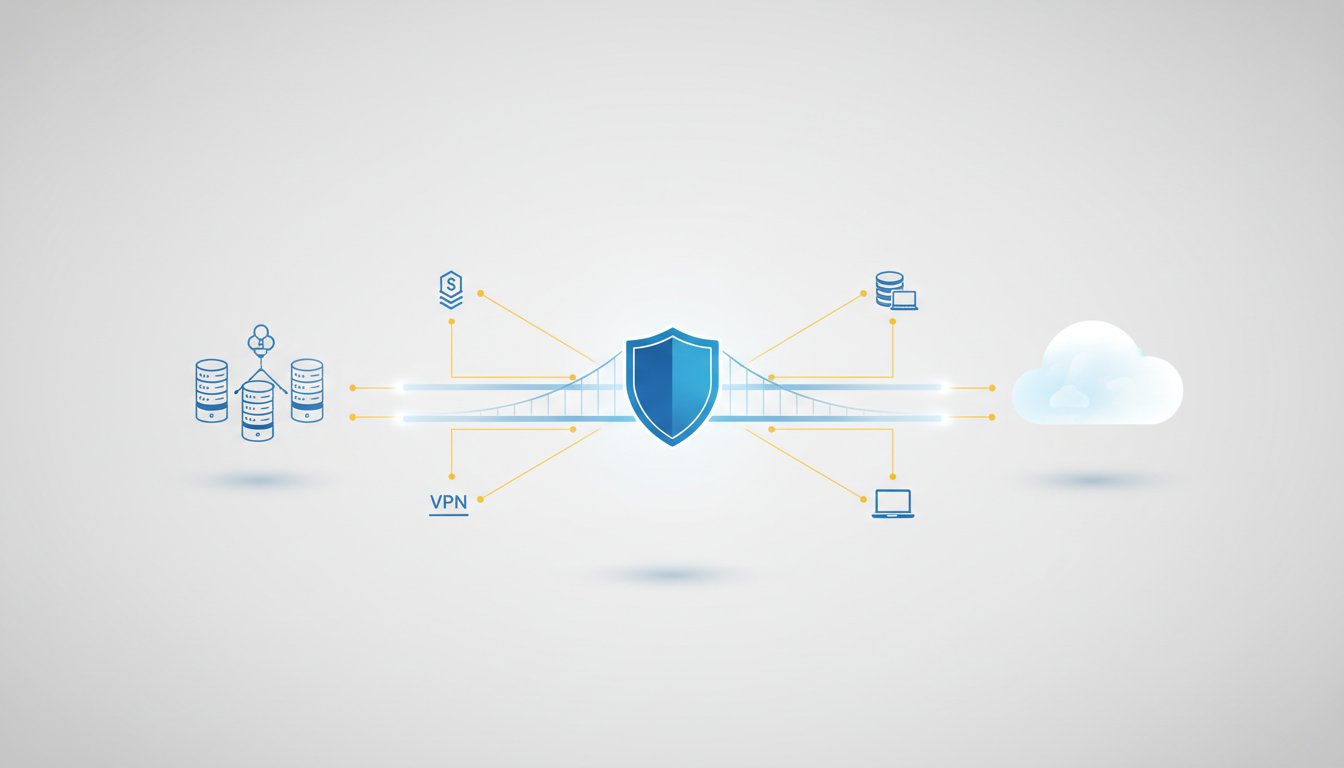
Your IT landscape is evolving, blending critical on-premises infrastructure with the flexibility of modern cloud applications. This creates a complex security challenge: how do you enforce strong, consistent authentication across both worlds without sacrificing control or agility? For a growing number of enterprises, the answer is a comprehensive hybrid cloud mfa strategy, designed to bridge this exact gap and provide simply strong security everywhere.
A cloud-only solution can mean losing oversight of core assets, while traditional on-prem MFA can’t easily extend to new SaaS apps. A hybrid approach eliminates this compromise. It delivers the robust, direct control you demand for your data center and the effortless flexibility needed to secure your cloud services, creating a single, unified security model for your entire organization.
In this guide, we’ll show you why this solution is essential for the modern enterprise. You will learn how a hybrid MFA approach protects your complete IT ecosystem, from legacy servers to the latest apps, delivering peace of mind for your team and a consistent, intuitive login experience for every user.
Key Takeaways
- Learn how a hybrid MFA model provides a single security layer for both your on-premises infrastructure and cloud applications.
- Uncover the key business benefits of this approach, from streamlined administration to a consistent security posture across your entire IT ecosystem.
- Understand how a hybrid cloud mfa solution works to protect critical access points, including VPNs, Windows Logons, and cloud services.
- Identify the essential features to look for when selecting an MFA vendor to ensure a secure, flexible, and future-proof deployment for your organization.
Table of Contents
- What is Hybrid Cloud MFA? Defining the Modern Security Model
- Why Choose a Hybrid MFA Approach? Key Benefits for Your Business
- How Does Hybrid Cloud MFA Work? Core Components and Architecture
- Common Use Cases for Hybrid MFA Deployments
- Choosing the Right Hybrid MFA Solution: Key Considerations
What is Hybrid Cloud MFA? Defining the Modern Security Model
A hybrid cloud environment combines your private, on-premises infrastructure with public cloud services. This model offers incredible flexibility, but it also creates a complex security landscape that demands a specialized approach: hybrid cloud mfa. To protect it, you need more than just a password. You need Multi-Factor Authentication (MFA)-a security method that requires users to provide two or more verification factors to gain access. If you’re wondering what Multi-Factor Authentication is, it’s the principle of adding layers to your security, making it exponentially harder for unauthorized users to get in.
This unified security model applies the principle of MFA across your entire digital estate. Think of it like a single, universal keycard. The same secure credential that grants an employee access to your physical office building should also unlock their cloud-based apps and on-premises servers. It’s one consistent, strong security standard for every resource, everywhere.
The Problem: The Security Gap in Hybrid Environments
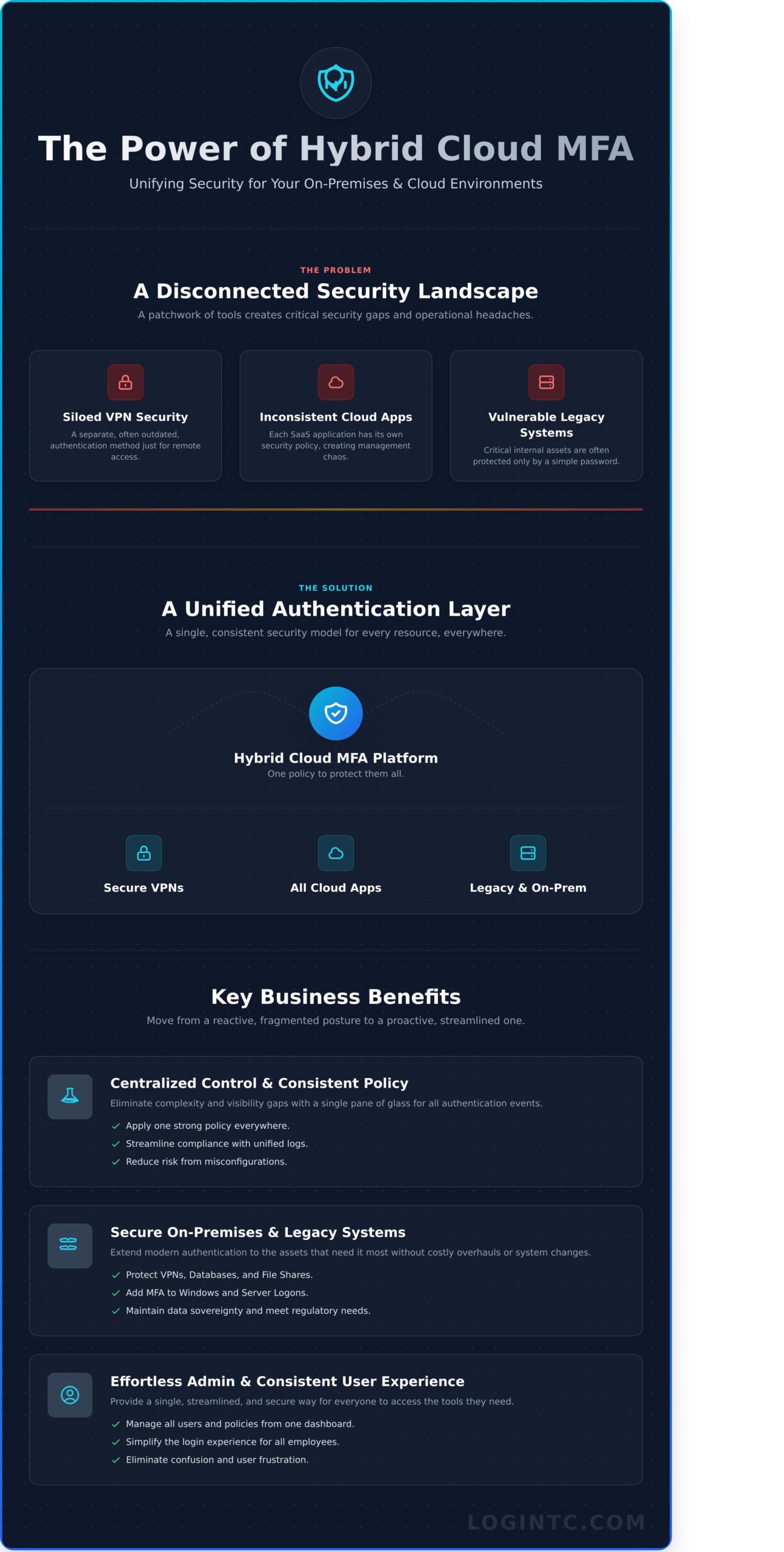
The reality for most organizations is a patchwork of disconnected security tools. You might have one solution for your VPN, another for your cloud apps, and yet another for privileged server access. This approach creates critical security gaps and operational headaches. Policies are inconsistent, user experiences are disjointed, and administrators are left managing a complex web of systems. Securing your cloud resources is vital, but leaving your on-premises assets behind a simple password is a risk you can’t afford.
The Solution: A Unified Authentication Layer
A true hybrid cloud mfa solution bridges this gap. It acts as a single, unified authentication layer that connects your on-premises directories (like Active Directory) with all your cloud services and internal applications. This centralized approach delivers immediate benefits:
- Effortless Administration: Manage all users, policies, and access rights from a single, intuitive dashboard. We believe administrators are users too, and their experience should be simple.
- Consistent User Experience: Provide your team with one streamlined, secure way to log in to every tool they need, eliminating confusion and frustration.
- Comprehensive Security: Enforce strong, consistent authentication policies across every access point, balancing robust security control with the operational flexibility your business requires.
By selecting a hybrid cloud approach, you eliminate the trade-off between security and agility. You gain a unified security architecture built for the modern, hybrid enterprise.
Why Choose a Hybrid MFA Approach? Key Benefits for Your Business
Understanding what a hybrid cloud is solves only part of the puzzle. For IT leaders and CISOs, the critical question is why this model is essential for modern cybersecurity. A hybrid approach isn’t a compromise; it’s a strategic decision to gain comprehensive control over a complex digital estate. By unifying security across diverse environments, the strategic value of hybrid cloud mfa becomes clear, providing a single, authoritative framework to protect every access point.
This model moves your organization from a reactive, fragmented security posture to a proactive, streamlined one, delivering tangible benefits that strengthen security and simplify administration.
Centralized Control and Consistent Policy Enforcement
Managing separate security solutions for cloud and on-premises resources creates complexity and dangerous visibility gaps. A unified hybrid MFA platform eliminates this risk by providing a single pane of glass for all authentication events. This centralized approach ensures that the benefits of multi-factor authentication are applied consistently everywhere.
- Apply One Policy: Enforce one set of strong, adaptive MFA policies across all applications, whether they are in your data center or the cloud.
- Simplify Compliance: Streamline audits with a single, comprehensive source of authentication logs and reporting.
- Reduce Misconfigurations: Minimize the risk of human error that comes from managing multiple, disconnected security systems.
Securing Legacy Systems and On-Premises Resources
Many critical on-premises applications and legacy systems were not designed for modern security threats and do not natively support MFA. A hybrid cloud mfa solution acts as a bridge, extending strong authentication to the assets that need it most. Protect your VPNs, internal databases, Windows Logon, and critical file shares without costly overhauls.
This approach also allows you to maintain data sovereignty and meet strict regulatory requirements by keeping sensitive authentication components within your own network. You gain modern security without sacrificing control. Explore on-premises MFA for ultimate control over your infrastructure.
Future-Proof Flexibility and Scalability
Your business is not static, and your security shouldn’t be either. A flexible MFA solution is designed to grow with you. It provides the agility to adapt to changing business needs, from cloud migration initiatives to supporting a distributed workforce, all without being locked into a single vendor’s ecosystem.
- Adapt to Growth: Easily add new cloud applications or on-premises systems to your security framework as your organization evolves.
- Enable Remote Work: Provide secure, frictionless access for your remote and hybrid workforce, no matter where they connect from.
- Avoid Vendor Lock-In: Choose a solution that integrates with your entire tech stack, not just one part of it.
Simplified Administration Across Your Entire Environment
No more juggling multiple consoles, separate vendor dashboards, or disjointed security tools. A unified hybrid MFA solution provides one administrative panel for everything. From this single point of control, you manage all users, enforce security policies, monitor access logs, and respond to security incidents—whether the access point is an on-prem server or a SaaS application. This approach reduces complexity, saves valuable IT time, and minimizes the risk of human error.
How Does Hybrid Cloud MFA Work? Core Components and Architecture
The strength of a hybrid cloud MFA solution lies in its intelligent architecture, which divides responsibilities between your secure on-premises environment and a flexible cloud service. This model provides robust security without sacrificing administrative simplicity, creating the foundation for secure hybrid working. The entire authentication process is a seamless interaction between three core components.
To understand how these pieces work together, let’s follow a typical user login request from start to finish:
- A user enters their username and password to access a protected resource (like a VPN or web application).
- The request is sent to the on-premises LoginTC Connector, which validates the primary credentials against your local Identity Provider (e.g., Active Directory).
- Once the password is confirmed, the Connector securely signals the LoginTC Cloud Management Plane to initiate the second factor. The user’s password never leaves your network.
- The Cloud Plane sends an MFA challenge (like a push notification) to the user’s registered device.
- The user approves the request, and the approval is sent back to the Cloud Plane.
- The Cloud Plane informs the on-premises Connector of the successful authentication, and the Connector grants the user access.
The On-Premises Component: The Connector
The Connector is a lightweight, secure agent that you install inside your network perimeter. It acts as the essential bridge between your internal systems and the LoginTC cloud. Its primary job is to communicate with your local identity store and securely relay authentication requests and responses. This design ensures that your most sensitive credentials, like Active Directory passwords, remain safely on-premises at all times, providing critical peace of mind.
The Identity Provider (IdP)
Your Identity Provider is the authoritative source of truth for your user identities. In a hybrid model, this is typically an on-premises directory like Microsoft Active Directory. The LoginTC Connector integrates directly with your IdP to verify a user’s primary credentials. By leveraging industry-standard protocols like RADIUS and SAML, our hybrid cloud mfa solution connects this central identity source to all your applications, whether they are in the cloud or on-premises, for consistent security everywhere.
The Cloud Management Plane
This is your central command center for MFA administration. Hosted by LoginTC, the Cloud Management Plane is where you configure security policies, manage users and devices, and view detailed logs and reports. When an MFA challenge is needed, this service processes the request and delivers it to the end-user. By offloading this infrastructure to the cloud, you gain effortless, scalable management without the cost and complexity of hosting it yourself.
Common Use Cases for Hybrid MFA Deployments
A hybrid cloud strategy introduces unique security challenges, but the right multi-factor authentication solution turns complexity into a strategic advantage. A flexible hybrid cloud mfa deployment provides a unified security layer that protects your critical assets, no matter where they reside. Below are common, real-world scenarios where LoginTC provides a simply strong solution to protect your business.
Securing VPN and Remote Desktop Access
Problem: Your VPN and RDP gateways are the front doors to your corporate network. A single compromised password can give an attacker complete access, putting your entire infrastructure at risk.
Solution: LoginTC seamlessly integrates with your existing infrastructure, including RADIUS-based VPNs and Windows Logon, to add a critical layer of MFA. Every remote login attempt requires a second factor of authentication, stopping credential theft in its tracks and ensuring only authorized users gain access.
Benefit: By fortifying these entry points, you protect your entire network from unauthorized access. Explore our full range of MFA security solutions to secure every access point and gain complete peace of mind.
Protecting Both On-Prem Exchange and Cloud Apps like Microsoft 365
Problem: Many organizations rely on a mix of legacy on-premise applications like Microsoft Exchange alongside modern cloud suites like Microsoft 365. Securing both with separate solutions creates a disjointed user experience and administrative overhead.
Solution: LoginTC provides a single, unified MFA policy that protects both on-premise Outlook Web Access (OWA) and cloud-based Microsoft 365 logins. Users enroll once and have a consistent, intuitive authentication experience everywhere.
Benefit: This approach eliminates security gaps and simplifies administration, providing a seamless and secure workflow for your users whether they are accessing an application on-site or in the cloud.
Enabling Secure Access for Third-Party Contractors
Problem: Granting temporary network access to contractors, vendors, or partners is a necessity, but it also introduces significant security risks. You need to provide limited access without creating a permanent vulnerability.
Solution: A hybrid cloud mfa strategy from LoginTC allows you to enforce strong authentication for all third-party users, ensuring they can only access the specific on-premise or cloud resources they are authorized for.
Benefit: With a centralized management console, administrators can easily provision, monitor, and de-provision contractor access in minutes. This gives you complete control and visibility, simplifying a complex but critical security task.
Choosing the Right Hybrid MFA Solution: Key Considerations
Selecting the right multi-factor authentication solution for your hybrid environment is a critical decision. It’s not just about adding a layer of security; it’s about finding a partner that integrates seamlessly with your existing infrastructure, simplifies administration, and provides a frictionless experience for your users. As you evaluate your options, use this checklist to identify a platform that delivers comprehensive security without adding unnecessary complexity.
Integration and Compatibility
Your chosen hybrid cloud mfa solution must work with what you already have. A platform that requires you to replace core components of your infrastructure is not a solution-it’s another problem. Look for flexibility and extensive support.
- Broad Connector Library: Does the vendor support standard protocols like RADIUS and SAML, along with modern APIs, to protect everything from your VPNs and firewalls to custom applications?
- Identity Store Support: Ensure it integrates directly with your on-premise identity stores, such as Active Directory or LDAP, to leverage your existing user directory without complex synchronization.
Deployment and Administration
Security is hard, but administration shouldn’t be. The ideal solution empowers your IT team, not burdens it. The deployment process for the on-premise components should be straightforward, and daily management should be intuitive.
- Rapid Implementation: Can the solution be deployed in hours, not weeks? Look for vendors that promise a streamlined setup process.
- Effortless Management: Is the administrative console clean, centralized, and easy to navigate? See how the LoginTC MFA product makes administration effortless, because we believe administrators are users too.
User Experience and Authentication Methods
The most secure MFA is the one your users will actually use. A poor user experience leads to frustration, support tickets, and potential security workarounds. Prioritize solutions that are both strong and simple.
- Flexible Methods: Does it offer a range of user-friendly authentication methods like push notifications, biometrics, and one-time passcodes?
- Simple Enrollment: Is the end-user enrollment process self-guided and quick to complete?
- Reliability and Offline Access: The system must be highly available to prevent user lockout. Support for offline access is also crucial for users in disconnected environments.
Ultimately, the best hybrid cloud mfa platform provides peace of mind by balancing robust security with operational simplicity. It protects your assets wherever they reside-on-premises or in the cloud-while ensuring both administrators and end-users have an intuitive experience. LoginTC was designed from the ground up to meet these exact requirements, offering a simply strong solution for your hybrid world. Discover how we make security easy at logintc.com.
Unify Your Security with a Simply Strong Hybrid Approach
In today’s complex IT landscape, securing every access point is non-negotiable. A hybrid approach provides the ultimate flexibility, bridging the gap between your critical on-premises infrastructure and your growing suite of cloud services. The right hybrid cloud mfa solution empowers your organization to enforce consistent, strong authentication across all applications, ensuring you never have to choose between comprehensive security and operational agility. It is the definitive modern security model for businesses in transition.
Making this transition is simpler than you think. LoginTC provides an MFA solution that is both powerful and pragmatic. Trusted by diverse organizations in over 100 countries, our platform is ISO 27001 Certified, meeting world-class security standards. We believe administrators are users too, which is why we’ve focused on effortless administration and an intuitive user experience. Deployment is so streamlined, it can be completed in as little as one hour.
Experience the control and peace of mind that comes from a truly unified security posture. Start your free trial and secure your hybrid cloud today.
Frequently Asked Questions About Hybrid Cloud MFA
What is the main difference between hybrid MFA and pure on-premises MFA?
A pure on-premises MFA solution keeps all authentication components, including user data and policies, within your private network for maximum control. A hybrid model combines the security of on-premises components with the flexibility of the cloud. This allows you to protect both legacy systems and modern cloud applications from a single, streamlined platform, giving your organization the best of both worlds without compromising on security or control.
Can hybrid cloud MFA work if our internet connection goes down?
Absolutely. This is a key advantage of the LoginTC hybrid model. Because core authentication components reside on-premises within your network, your internal systems remain protected and accessible even during an internet outage. Your team can continue to securely access critical on-prem resources like Windows Logon and RDP without interruption. This design ensures operational continuity and provides peace of mind when external connectivity is unreliable.
Is a hybrid MFA solution more complex to manage than a cloud-only one?
While some hybrid solutions add complexity, we believe administrators are users too. LoginTC is engineered for effortless administration. Our solution uses lightweight on-premises connectors that are simple to deploy and manage from a single, intuitive administrative panel. This unified approach removes the complexity often associated with managing disparate on-prem and cloud systems. You get comprehensive protection without the administrative burden, making strong security simple to maintain.
How does hybrid MFA help with data residency and compliance requirements like GDPR?
A hybrid MFA model gives your organization precise control over where sensitive data is stored. With LoginTC, all personally identifiable information (PII) and user directories remain within your on-premises environment, never touching the public cloud. This architecture directly supports strict data residency requirements and simplifies compliance with regulations like GDPR, CCPA, and HIPAA. You can confidently meet your regulatory obligations while leveraging a modern authentication platform.
What kind of systems can be protected with a hybrid MFA model?
The flexibility of a hybrid cloud mfa model is one of its greatest strengths, allowing you to secure a comprehensive range of assets across your entire IT landscape. This includes on-premises systems like Windows Logon, Remote Desktop (RDP), and VPNs (Cisco, Palo Alto Networks), as well as cloud applications like Microsoft 365 and Google Workspace. Our solution provides a single, consistent layer of strong authentication for your legacy infrastructure and modern services.
How long does it typically take to deploy a hybrid MFA solution?
Unlike other MFA solutions that take days or weeks of complex configuration, LoginTC’s hybrid solution is designed for rapid deployment. Our streamlined process and lightweight connectors mean that many organizations can be fully operational in just one hour. We provide clear documentation and hands-on expert support to ensure your deployment is fast, efficient, and successful, allowing you to strengthen your security posture without lengthy implementation projects.