MFA Solution Cost: A Complete Guide to Pricing and TCO
February 12, 2026 •
Comparing multi-factor authentication vendors can be frustrating. Pricing models often seem intentionally opaque, making it nearly impossible to calculate the true mfa solution cost for your organization. You’re left worrying about hidden fees, unexpected support charges, and the ongoing resources required for maintenance. This uncertainty makes it difficult to budget effectively and even harder to justify the expense to leadership.
Our business is protecting your business-and that includes protecting your budget. This comprehensive guide moves beyond the sticker price to demystify the Total Cost of Ownership (TCO) for an MFA solution. We’ll break down every component, from initial deployment and hardware needs to ongoing administration and end-user training. You’ll gain the clarity needed to accurately compare cloud versus on-premises options and ask vendors the right questions.
By the end, you’ll be equipped to build a realistic budget, confidently evaluate quotes, and demonstrate the clear ROI of a strong authentication strategy. Let’s make your next security investment a decision you can make with total confidence.
Key Takeaways
- Understand common MFA pricing models, from per-user to per-authentication, to accurately compare vendor proposals.
- Look beyond the sticker price by identifying the indirect expenses-like implementation, training, and administration-that impact your total cost.
- Discover how your deployment choice between on-premises and cloud fundamentally changes the long-term mfa solution cost and budget requirements.
- Learn to calculate the true ROI of your MFA investment by weighing its cost against the far greater expense of a single security breach.
Decoding MFA Pricing Models: How Vendors Structure Their Costs
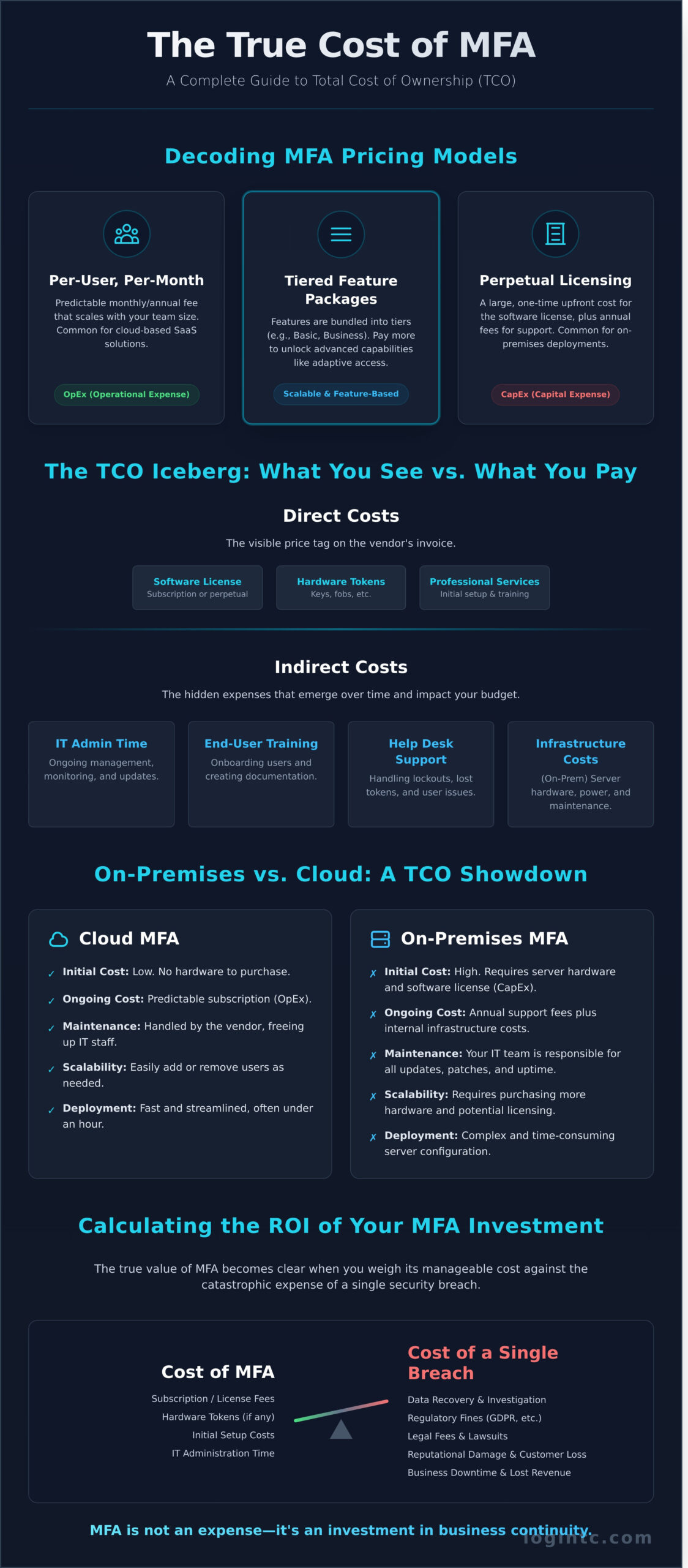
To accurately calculate your total cost of ownership, you must first understand how vendors bill for their services. The pricing model is the foundation of your total mfa solution cost, and comparing solutions without this knowledge can be misleading. Before you can analyze specific numbers, it’s critical to understand the core delivery models for Multi-factor authentication (MFA). Knowing these structures allows you to make an apples-to-apples comparison and select the solution that best aligns with your organization’s budget, user count, and security requirements.
Per-User, Per-Month Subscription (SaaS Model)
This is the most common model for cloud-based MFA solutions. It provides a predictable operational expense (OpEx) that scales directly with your team size. The monthly or annual fee typically includes all support, maintenance, and software updates, simplifying your budget. As your organization grows, look for vendors that offer volume discounts to ensure the solution remains cost-effective and provides long-term value.
Tiered Feature Packages
Many vendors bundle features into distinct packages, often labeled as Basic, Business, or Enterprise. Moving to a higher tier unlocks advanced capabilities such as device trust, adaptive access policies, or comprehensive reporting. Carefully evaluate which features are essential for your security posture. The key is to select a tier that meets your needs without overpaying for premium functionality you will never use. A pragmatic assessment here prevents unnecessary spending.
Perpetual Licensing (On-Premises Model)
Common for on-premises or air-gapped deployments, this model involves a one-time, upfront capital expense (CapEx) for the software license. This purchase grants you indefinite ownership of the software. However, this initial investment is almost always paired with a mandatory annual fee for ongoing support and maintenance. This structure provides maximum control over your environment but requires a different budgeting approach than a recurring subscription.
Direct Costs: The Line Items on Your Invoice
When calculating your on-premises mfa solution cost, the direct costs are the most straightforward. These are the tangible, predictable expenses you will discuss with a vendor’s sales team and see on a formal quote. They form the foundation of your initial budget and are critical for comparing providers. However, it’s vital to remember that these figures represent only one part of the total cost of ownership. For complete clarity, always request a detailed quote that breaks down each line item.
Software Licensing or Subscription Fees
This is the core expense of your MFA deployment. The cost is typically determined by a specific pricing model, and understanding its structure is key to avoiding unexpected fees. When evaluating a solution, be sure to clarify:
- Pricing Model: Is the license based on user count, a specific feature tier, or a combination of both?
- Billing Cycles: Are there discounts for annual billing compared to monthly subscriptions?
- User Definitions: How does the vendor count inactive, dormant, or guest users? This can significantly impact your long-term cost.
Hardware Tokens and Authenticators
While many modern MFA solutions leverage free smartphone apps for authentication, some environments require or prefer physical hardware. These security keys (like YubiKeys) are usually a separate, one-time purchase per user. Implementing MFA is considered one of the most effective controls for securing your accounts, and your choice of authenticator impacts direct costs. You must budget for the initial hardware deployment and a surplus for replacing lost or damaged tokens over time.
Professional Services and Initial Setup
Some vendors charge a one-time fee for professional services to guide your implementation. This can include initial server configuration, integration with your existing systems, and administrator training sessions. While this adds to your upfront mfa solution cost, it can accelerate deployment and ensure your system is configured correctly for maximum security. Unlike solutions that require extensive paid support, LoginTC is designed for a streamlined one-hour deployment, empowering your team to get protected quickly and minimizing this expense.
Indirect Costs: The Hidden Expenses That Impact Your Budget
The sticker price of an on-premises multi-factor authentication system is only one part of the equation. The true mfa solution cost is revealed when you account for the indirect, or ‘soft,’ costs associated with its deployment and daily operation. These expenses are often overlooked during procurement but can significantly impact your IT budget and team resources over time. Factoring these hidden costs into your TCO calculation is critical for preventing budget overruns and ensuring a smooth, successful implementation.
This is where ease-of-use and intuitive administration tools provide a clear return on investment. A well-chosen solution minimizes these hidden operational drains, protecting both your budget and your team’s valuable time.
Internal Staff Time for Implementation and Management
Your IT team’s time is a direct cost. When evaluating an MFA solution, calculate the hours your team will spend on initial setup, deployment, and configuration. Beyond the launch, consider the ongoing administrative burden. Daily tasks like enrolling new users, managing access policies, and troubleshooting issues can consume significant resources. A solution with a streamlined, intuitive admin panel is essential, as it directly reduces this ongoing time commitment and frees your experts to focus on other critical initiatives.
End-User Training and Productivity
Security measures should empower your organization, not hinder it. A complex MFA workflow can lead to a dip in productivity as employees adapt. You must factor in the time spent training staff on the new login process and the cost of increased helpdesk tickets for issues like account lockouts or lost authenticators. A simple, user-friendly authentication experience is crucial to minimize friction, accelerate adoption, and reduce the support burden on your IT department.
Integration with Your Existing Infrastructure
Your MFA solution must protect every access point, from VPNs and firewalls to cloud and legacy applications. The cost and complexity of connecting MFA to your entire tech stack can vary dramatically. Some integrations may require specialized expertise or costly custom development work. To avoid these expenses, verify that the vendor provides pre-built connectors for the systems you rely on. Explore our wide range of MFA integration solutions to ensure seamless compatibility and a straightforward deployment.
On-Premises vs. Cloud MFA: A Total Cost of Ownership Comparison
Your deployment model-cloud or on-premises-is one of the most significant drivers of your total cost of ownership (TCO). While both provide strong security, their financial structures are fundamentally different. A cloud solution offers predictable operational expenses and rapid deployment, whereas an on-premises deployment provides greater control and can yield a lower TCO over the long term. Choosing the right model is a strategic decision that depends on your organization’s security posture, IT resources, and budget strategy.
The Cost Profile of Cloud MFA
Cloud-based MFA operates on a subscription model, shifting the cost from a large upfront investment to a predictable, recurring operational expense (OpEx). This approach simplifies budgeting and eliminates the need to procure or manage physical infrastructure. The primary components include:
- Predictable Subscription Fees: The core cost is a recurring per-user fee, making the overall mfa solution cost easy to forecast.
- Zero Infrastructure Overhead: You avoid all costs associated with server hardware, data center space, power, and cooling.
- Vendor-Managed Security: The provider handles all updates, security patching, and uptime, giving your IT team peace of mind.
This model is ideal for organizations that prioritize speed, simplicity, and a hands-off approach to infrastructure management.
The Cost Profile of On-Premises MFA
An on-premises MFA solution typically involves a higher initial capital expenditure (CapEx) for licenses and the physical or virtual servers to host the software. While the initial investment is larger, it can lead to a lower total cost of ownership over several years by eliminating recurring subscription fees. Key cost factors are:
- Upfront Investment: Costs include perpetual software licenses and the server infrastructure to run the solution.
- Internal Responsibility: Your team is responsible for all maintenance, updates, and system uptime, which requires dedicated IT resources.
- Complete Control: Your data and authentication processes remain entirely within your network, satisfying strict compliance and data residency requirements.
For organizations seeking ultimate control and security, LoginTC offers a robust on-premises MFA solution built for high-security environments. By understanding these cost structures, you can select the deployment model that best aligns with your business needs.
Calculating ROI: The True Value of Your MFA Investment
After calculating the Total Cost of Ownership (TCO), the final step is to frame it correctly. An on-premises MFA solution is not an expense; it is a critical business investment with a clear and compelling return. When you compare the comprehensive mfa solution cost to the catastrophic cost of a single security incident, the value becomes immediately apparent. This framework helps justify the security budget to leadership by focusing on risk mitigation and business enablement.
Security is hard, but protecting your assets should be straightforward. The true value of MFA is measured not just in dollars saved, but in the operational continuity, brand reputation, and peace of mind it secures for your organization.
The Cost of a Data Breach
According to IBM’s 2023 report, the average cost of a data breach has reached an all-time high of $4.45 million. This figure extends far beyond initial damages and includes a wide range of expenses that can impact your business for years. MFA is one of the single most effective controls for preventing unauthorized access, the leading cause of data breaches.
- Investigation and Remediation: Forensic analysis, system restoration, and security upgrades.
- Notification and Support: Costs associated with notifying customers, regulators, and providing credit monitoring services.
- Lost Business: Downtime, customer churn, and long-term reputational damage.
Regulatory Compliance and Fines
Modern data privacy regulations are no longer optional. Frameworks like GDPR, HIPAA, and PCI DSS often mandate strong authentication controls to protect sensitive information. Non-compliance can result in severe financial penalties, audits, and legal action that can easily dwarf the initial mfa solution cost. Implementing a robust MFA solution is a proactive, foundational step toward meeting these stringent requirements and avoiding costly fines.
Cyber Insurance Premiums
In today’s high-risk environment, cyber insurance providers have become far more selective. Multi-factor authentication is now a baseline requirement for policy eligibility and renewals. Organizations without MFA face either outright denial of coverage or prohibitively expensive premiums. By deploying a comprehensive MFA solution, you not only secure coverage but also demonstrate a commitment to a strong security posture, which can lead to more favorable terms and lower annual costs.
Ultimately, a strong security posture is your best policy. To see how an on-premises MFA solution can deliver a powerful ROI for your organization, explore LoginTC’s Simply Strong authentication.
Find Clarity in Your MFA Solution Cost
Understanding the total cost of ownership for multi-factor authentication goes far beyond the initial quote on an invoice. As we’ve explored, the true mfa solution cost is a comprehensive figure that includes indirect expenses like administration time, end-user training, and the operational impact of deployment. A clear evaluation, comparing the TCO of on-premises versus cloud deployments, is essential to grasping the full financial picture and the ultimate ROI of preventing a costly breach.
At LoginTC, we remove the complexity. We provide transparent pricing because our business is protecting your business. Our ISO 27001 Certified security delivers the peace of mind you need, whether you choose our flexible cloud solution or our expert on-premises and air-gapped deployments. Unlike solutions that take weeks to implement, LoginTC offers simply strong security that can be deployed in just one hour, saving you valuable time and resources.
Ready to move forward with confidence? See our straightforward pricing and calculate your cost. Protecting your organization is the best investment you can make.
Frequently Asked Questions
Is a free MFA solution good enough for my business?
While free MFA options provide a basic security layer, they often lack the critical features and dedicated support your business requires for robust protection. Professional solutions deliver comprehensive application coverage, streamlined administration for your IT team, and access to expert support to resolve issues quickly. For true peace of mind and security that scales with your organization, investing in a dedicated, enterprise-grade MFA solution is the most reliable and effective choice for protecting your business.
How much does MFA cost for a small business of 50 users?
The mfa solution cost for a 50-user business is designed to be accessible and predictable. Pricing is typically calculated on a per-user, per-year basis, ensuring you only pay for what you need. For an on-premises solution, this annual subscription often includes all software updates, ongoing maintenance, and direct access to expert technical support. This straightforward model eliminates surprise fees and provides a clear, cost-effective path to strengthening your organization’s cybersecurity posture.
What are the ongoing costs of an MFA solution after the first year?
For most on-premises MFA solutions, the primary ongoing cost is the annual subscription fee. This fee typically covers your user licenses, all software updates, and continued access to professional support. Unlike solutions with complex pricing, our model is designed for simplicity and predictability. This ensures your Total Cost of Ownership (TCO) remains low and transparent, without hidden charges for standard maintenance or expert assistance, giving you continued peace of mind year after year.
Do I have to pay extra for hardware security tokens?
Hardware security tokens are typically a separate, one-time purchase, as they are physical devices. However, a flexible MFA solution should not lock you into a single authentication method. A strong solution supports a wide range of authenticators, including software-based push notifications and OTPs on mobile devices, which carry no extra hardware cost. This allows you to implement a cost-effective security strategy by mixing methods to fit your specific user needs and budget.
How can I get an accurate MFA quote for my organization’s specific needs?
The most effective way to determine your specific mfa solution cost is to request a personalized quote. Our cybersecurity experts will work with you to understand your unique environment, including the number of users, the applications you need to protect, and your preferred authentication methods. This collaborative process ensures the quote is tailored precisely to your requirements, providing a clear and comprehensive TCO calculation with no obligations. Contact our team to get your accurate quote today.
Does the cost of MFA include protection for all my applications?
A comprehensive MFA solution should protect your entire technology stack without complex, per-application fees. Our licensing is based on the number of users, not the number of integrations. This means your subscription includes protection for all your critical systems, from VPNs and firewalls to Windows Logon and web applications, using our powerful connectors. This all-inclusive approach simplifies your security management and ensures your investment provides maximum value across your whole organization.