Microsoft Is Retiring SMS and Voice MFA in Entra ID: The Dates, the Scope, and What to Do Before February 2027
August 28, 2026 •
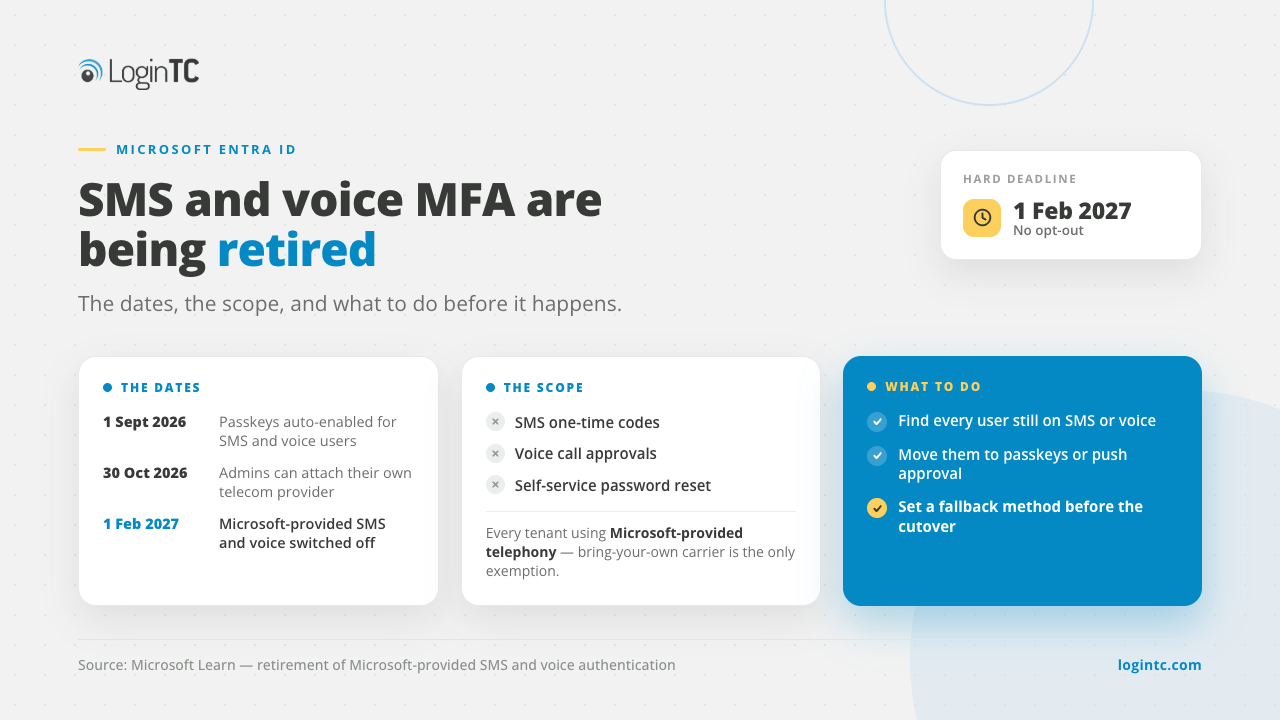
If any of your users receive a text message or a phone call to complete multi-factor authentication, this affects you on a fixed schedule, and the first date is days away.
Microsoft announced the change on 13 July 2026 and notified tenants as Message Center post MC1426371. This post covers what is actually being retired, the four dates that matter, how to work out who in your tenant is affected, what to move them to, and how to plan the migration without breaking sign-in for thousands of people at once.
What Microsoft is actually retiring, and what it is not
Before you plan anything, be precise about the scope. A lot of the coverage has flattened this into “Microsoft is killing SMS MFA”, which is not what the documentation says.
What is being retired
- Microsoft-provided SMS one-time passcodes for Entra ID multi-factor authentication
- Microsoft-provided automated voice call verification for Entra ID multi-factor authentication
- The same methods where they are used for self-service password reset. Microsoft’s FAQ confirms the change applies across Entra, including SSPR
What is not being retired
- External authentication methods. Microsoft’s FAQ states that external MFA users are not in scope unless they are also enabled for SMS or voice, and that clause matters, as explained below
- SMS or voice delivered by a provider other than Microsoft. Microsoft is retiring its own delivery pipeline, not the method category
- Microsoft Authenticator push notifications and passwordless phone sign-in
- FIDO2 security keys and passkeys registered in Entra ID
- Certificate-based authentication
- Azure AD B2C, which is explicitly out of scope. Microsoft Entra External ID gets a separate announcement next year
The distinction is who sends the message. If your users receive a code from a Microsoft phone number, you are affected. If they receive it from a third-party MFA provider you already pay for, this particular change does not touch you.
One related change that is not part of this retirement: Conditional Access custom controls are being retired on their own timeline, and can already no longer be created or edited. The dates and the migration path are in Microsoft is retiring Conditional Access custom controls.
The four dates that matter
| Date | What happens | What you decide |
|---|---|---|
| 1 September 2026 | Passkeys become the default experience. Every user enabled for SMS or voice, in either the Authentication Methods Policy or legacy MFA settings, is automatically enabled for passkeys. A registration campaign in the Microsoft managed state prompts them, with unlimited snoozes by default. | Accept the automatic enablement, or apply the temporary opt-out. |
| 18 September 2026 | Information about customer-managed telecom providers becomes available in the Microsoft Security Store. | Whether bringing your own telecom provider is worth pricing. |
| 30 October 2026 | Administrators can select and configure a telecom provider from the Security Store. | Procurement time, if you are taking that route. |
| 1 February 2027 | Microsoft-provided SMS and voice delivery is retired and enforcement begins. A user whose only available method is SMS or voice must register a passkey during sign-in. | Nothing. There is no opt-out. |
Dates from Microsoft Learn, “Passkeys by default and retirement of Microsoft-provided SMS and voice authentication”, and the Microsoft Security Blog announcement of 13 July 2026.
One exception to the February date. Microsoft’s retirement FAQ splits it by user type: 1 February 2027 for all users except Global Administrators and external users, and 1 July 2027 for Global Administrators and external users. Plan to February regardless. The five extra months apply to the accounts you least want to leave on a text message, not to the bulk of your users.
Why Microsoft is doing this
SMS has been the weakest widely deployed second factor for years, and the reasoning is not controversial.
SIM-swapping lets an attacker move your phone number to a device they control, after which every code sent to that number goes to them. The FBI’s Internet Crime Complaint Center reported roughly $68 million in losses from SIM-swap complaints in 2021. Beyond SIM swapping, SMS codes are exposed to SS7 protocol attacks and to real-time phishing kits that relay a code to the legitimate site faster than the user can finish reading it. NIST has designated SMS a restricted authenticator in SP 800-63B since 2017.
Microsoft’s own stated reason is that these methods rely on shared secrets and channels attackers intercept, phish or manipulate. In the announcement it cites threat intelligence showing AI-enabled phishing campaigns reaching click-through rates as high as 54 percent, against roughly 12 percent for more traditional campaigns, and notes that SIM swapping and MFA bypass have become more accessible and repeatable.
Work out your exposure first
The population that depends on SMS or voice is usually smaller than people assume and concentrated in predictable places.
Step 1. Run the authentication methods report. In the Microsoft Entra admin center, go to Protection, then Authentication methods, then User registration details. Filter for users who have only SMS or voice registered with no other method. Those are your highest-priority targets.
Step 2. Check your authentication methods policy. Under Protection, then Authentication methods, then Policies, check whether SMS and voice are enabled and which groups are in scope.
Step 3. Check legacy per-user MFA settings separately. Users enabled through legacy settings rather than the Authentication Methods Policy are in scope too, and legacy settings are exactly where forgotten configurations survive.
Step 4. Check SSPR on its own. Self-service password reset is often configured by a different team at a different time. Under Protection, then Password reset, then Authentication methods, check whether mobile phone or office phone are enabled as reset options.
Microsoft also publishes a read-only PowerShell script for this, the Entra SMS and voice usage analyzer. The tool is published on GitHub as entra-sms-voice-usage-analyzer. It is read-only: it reports which of your users have SMS or voice registered and changes nothing. If you have seen it referred to as the Entra SMS voice usage analyzer, this is the same script.
It reports your registration campaign state and your SMS and voice policy scope, and exports the targeted users and groups to CSV. It needs the Policy.Read.All and Group.Read.All Graph scopes and a role of Global Reader, Authentication Policy Administrator or Security Reader.
Segment your users before you plan the rollout
Not all users are equal in a migration, and the plan falls apart if you treat them as one population.
- Corporate device users. The easiest group. Push the replacement method through Intune or your MDM and most of them will never file a ticket.
- BYOD users. Need clear communication and self-service enrolment. Plan for support volume during the rollout rather than after it.
- Frontline and shared-device workers. Often have no personal smartphone available at the point of login. Security keys and hardware tokens are the realistic options here, not an app.
- External guests and partners. Depends on whether they authenticate into your tenant directly. Identify them early, because you control their behaviour least.
- High-privilege accounts. Migrate first, and to a phishing-resistant method rather than app-based push. Smallest population, largest consequence.
What to move people to
| Option | Best for | What it costs you |
|---|---|---|
| Passkeys | Staff with a supported device or a security key, on modern platforms. | Communication and help desk effort, plus hardware if you issue keys. The path Microsoft has optimised for and the strongest security outcome. |
| Another native Entra method | Users who can install an authenticator app. | Lowest change cost if they were on SMS out of habit. Does nothing for anyone who cannot use a smartphone. |
| Certificate-based authentication | Organizations with existing PKI, particularly government and defence contractors already on smart cards. | Only viable if the PKI already exists. Not a project to start because of this deadline. |
| Bring your own telecom provider | Organizations with a documented regulatory or operational need for SMS or voice specifically. | A vendor selection and contract from 30 October 2026, plus per-message charges. Microsoft states customers are responsible for telecom costs charged by the telecom partners. |
| An external authentication method | Organizations needing methods Entra does not offer, or that also protect systems outside the Microsoft stack. | A per-user subscription and an integration to configure. Requires Conditional Access, which requires Microsoft Entra ID P1 or higher. |
The trap: mixed enablement
One configuration will likely surprise people in February. Microsoft’s FAQ says external MFA users are not in scope unless they are also enabled for SMS or voice.
Being covered by another method does not remove a user from the retirement if SMS or voice is still switched on for them, in the Authentication Methods Policy or in legacy settings. So whichever route you take, part of the work is turning the old methods off for the people who have moved. Treat “the user has a new method” and “the old method is disabled for them” as two tasks with two verification steps.
A migration plan that does not break sign-in
Phase 1. Enable the replacement methods now. Turn them on in the Authentication Methods Policy today. If you are adding an external provider, register it and pilot with a small group. Early enablement buys you time to find problems while they are still small.
Phase 2. Communicate before you enforce. A user who gets an unexpected prompt to register a credential will either call the help desk or report it as phishing, and the security-aware ones will do the second. Explain what is changing and set a deadline several weeks before your internal one, so the buffer absorbs stragglers.
Phase 3. Drive registration with Conditional Access. A Conditional Access policy requiring registration before access moves a population faster than a manual campaign. One caution if you are using an external authentication method: Microsoft’s guidance is that external MFA is not currently compatible with authentication strengths, so build those policies on the standard Require multifactor authentication grant rather than Require authentication strength.
Phase 4. Disable SMS and voice for migrated groups. As each group completes registration, turn the old methods off for them. Do not wait for February. Removing the weaker method improves your position immediately and shrinks the population exposed to a last-minute failure.
Phase 5. Handle exceptions with a process. Some users will have a real reason they cannot use the default replacement. Define the exception route before you enforce, not during. Hardware security keys and hardware tokens cover most of these cases, and Temporary Access Passes help users stuck mid-transition. Document every exception and review the list quarterly, because an exception granted in October is how someone is locked out in March.
The group that decides how hard this is
Every plan meets the same obstacle: users who cannot register a passkey. Field staff without a corporate device, shift workers on shared stations, clinical staff at the bedside, contractors outside your device management, and anyone working where phones are not permitted.
Security keys, hardware tokens and offline-capable methods all provide a second factor without requiring the user to hold a phone. LoginTC integrates with Entra ID as an external authentication method and supports these alongside push, authenticator app and passcode grids, and the same subscription covers on-premises systems that Entra was never going to reach. The setup is documented in how to use LoginTC for Microsoft Entra ID external authentication methods, the framework itself in external authentication methods in Microsoft Entra ID, and the wider case in why choose third-party MFA for Entra ID.
If the plan is to replace Microsoft-delivered SMS with someone else’s SMS and change nothing else, you have solved a delivery problem rather than a security one. Text messages are still the weakest widely deployed second factor. The defensible use of SMS after February 2027 is as a documented, time-limited fallback for a named group while everyone else moves to phishing-resistant methods.
Further reading: the full method list on authentication solutions, hardware-based sign-in on the FIDO2 authentication page, and the options for users without a phone in how to securely authenticate without a smartphone.
Working out what to do with the users who cannot move to a passkey?
Talk to our team about adding LoginTC to Entra ID as an external authentication method, or start a free trial today. We support cloud, on-premises and hybrid deployments.
Frequently asked questions
What is the exact retirement date for Microsoft-provided SMS and voice MFA in Entra ID?
1 February 2027. On that date Microsoft-provided SMS and voice delivery is retired and enforcement begins across Entra, including self-service password reset. Before that, on 1 September 2026, passkeys become the default experience and users enabled for SMS or voice are automatically enabled for passkeys and prompted to register. Microsoft announced the change on 13 July 2026 and notified tenants as Message Center post MC1426371.
Does this affect third-party MFA providers that send SMS to users?
No. The retirement applies only to Microsoft-provided SMS and voice delivery. If your users receive codes from a third-party MFA provider connected to Entra ID through external authentication methods, that setup is not in scope. Microsoft is retiring its own delivery pipeline, not the method category. One clause is worth reading carefully though: Microsoft’s FAQ says external MFA users are not in scope unless they are also enabled for SMS or voice, so a user who has an external method assigned but still has SMS switched on for them is still affected. Disabling the old method for migrated users is a separate task from assigning them a new one.
Can I keep SMS or voice after February 2027?
Yes, by two routes. You can configure a customer-managed telecom provider through the Microsoft Security Store, with information available from 18 September 2026 and configuration from 30 October 2026, noting that Microsoft states customers are responsible for the telecom costs charged by the telecom partners. Or you can use a provider that delivers its own SMS and voice, which is not in scope for Microsoft’s retirement. Either way, treat SMS as a documented and time-limited fallback for a named group rather than a destination, because the SIM-swap and phishing weaknesses are properties of the channel and do not change with the sender.
Can I delay the change?
Partly. A tenant-level opt-out is available from 1 September 2026 until 1 February 2027, set through Microsoft Graph by patching the authentication methods policy with optOutSettings.passkeyDynamicMigration set to true, using the Policy.ReadWrite.AuthenticationMethod permission. It excludes the tenant from the automatic passkey enablement and the registration campaign during that window only. There is no mechanism to delay the 1 February 2027 retirement, and Microsoft’s documentation states there is no opt out from that behaviour and that it will be enforced for all tenants.
What should users with no smartphone use instead?
A different strong method rather than a weaker one. FIDO2 hardware security keys work with any device that has a USB or NFC port and need no smartphone. Windows Hello for Business provides a device-bound passkey experience on Windows machines. Hardware one-time passcode tokens, passcode grids and offline-capable methods cover users that neither of those reaches. Certificate-based authentication is an option for organizations that already run a PKI, though it is not a project worth starting because of this deadline alone.
Will self-service password reset be affected?
Yes. Microsoft’s FAQ states the retirement applies across Entra, including SSPR. If mobile phone or office phone is configured as a verification option for password reset in your tenant, review that separately from your MFA policy, because the two are often configured by different teams at different times. Note also that SSPR is subject to a second, earlier change requiring explicitly registered authentication methods, with its own date in November 2026.
How do I find out how many of my users depend on Microsoft-provided SMS or voice?
In the Microsoft Entra admin center, go to Protection, then Authentication methods, then User registration details. Filter for users who have only SMS or voice registered with no secondary method. Check legacy per-user MFA settings as well as the Authentication Methods Policy, because users enabled through legacy settings are in scope too. Microsoft also publishes a read-only PowerShell script, the Entra SMS and voice usage analyzer, which exports the affected users and groups to CSV and needs only the Policy.Read.All and Group.Read.All Graph scopes.
Does this affect Azure AD B2C or Microsoft Entra External ID?
Azure AD B2C is explicitly out of scope and unaffected. For Microsoft Entra External ID, Microsoft’s FAQ indicates changes are coming next year under a separate announcement, with no immediate impact from this one. Track customer-facing identity separately from your workforce tenant.